Humayrah: A Display Font That Elevates Small Business Branding
Last Tuesday, I was helping a local candle maker finalize her new soy wax jar labels—simple kraft paper sleeves with gold foil accents—and she kept zooming in on the product name. “It just doesn’t *feel* like us yet,” she said, tapping her screen. The current font looked generic, almost apologetic—like it was trying to disappear instead of inviting attention. That’s when I opened Humayrah.
Within minutes, we swapped in the name “Amber Hearth” set in Humayrah’s regular weight—and suddenly, the label breathed. Not louder, but *clearer*. Warmer. More intentional. That’s the quiet power of a thoughtfully designed Arabic display font: it doesn’t shout; it settles into your brand like a well-tailored jacket.
What Makes Humayrah Feel So Distinctly Refined?
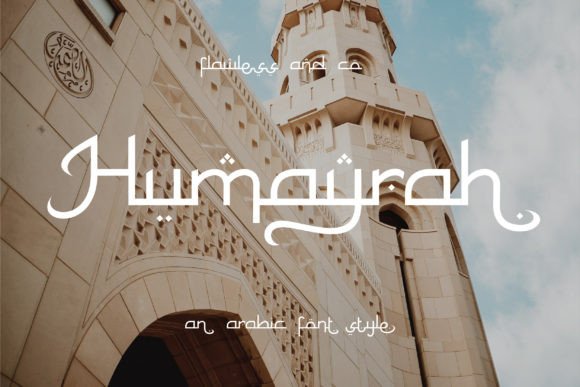
Humayrah isn’t built for body text or spreadsheets. It’s a premium display font—designed for moments that matter: your logo, your product title, your Instagram story headline, the “Handcrafted in Portland” line on your boutique tag. Every character is hand-drawn, then digitally refined to preserve organic rhythm and visual harmony. The curves are soft but confident. The spacing feels generous—not cramped, not sparse. And because it’s rooted in traditional Arabic calligraphy, there’s an inherent sense of craftsmanship and timelessness.
That elegance translates directly to how customers perceive your business. When someone sees Humayrah on a skincare label or a café menu, they don’t just read the words—they register care. Attention. Intention. In a world of rushed scroll-throughs and mass-produced aesthetics, that subtle cue builds trust before a single word is absorbed.
Where Humayrah Works Best (and Where to Use It Thoughtfully)
We tested Humayrah across real small business touchpoints—and here’s what stood out:
- Product labels & packaging: Perfect for short, high-impact names (“Saffron Honey,” “Cedar + Myrrh,” “Rosewater Mist”). On matte sticker stock or embossed kraft boxes, Humayrah adds tactile sophistication without needing extra design flourishes.
- Menus & printed collateral: Used sparingly as section headers (“Our Pastries,” “Seasonal Specials”)—never for full paragraphs—it creates visual hierarchy and warmth that complements clean photography.
- Social media graphics: Stands out beautifully in Instagram carousel headers or Pinterest banners. Its strong letterforms hold up even at smaller thumbnail sizes—no blurring, no loss of character.
- Thank-you cards & boutique tags: Paired with a light sans serif for the body copy, Humayrah gives handmade goods a quietly luxurious finish—like the difference between “thank you” and “with deep gratitude.”
One note on readability: Humayrah shines at 18pt and above for print, and 24px+ for web. Avoid using it for fine print, ingredient lists, or legal disclaimers—it’s not built for dense information. But for anything meant to be *felt*, not just scanned? It delivers.
Simple Pairings That Keep Your Brand Cohesive
Humayrah thrives in contrast. Its expressive flow pairs beautifully with understated companions—think of it as the soulful lead vocalist backed by a calm, grounded band.
A clean, neutral sans serif (like Poppins, Inter, or Montserrat) is our go-to pairing for almost every use case: product descriptions beneath a Humayrah headline, website subheadings, email subject lines, or shop banner text. The balance feels modern, approachable, and effortlessly professional.
For beauty or luxury brands, try Humayrah with a delicate serif—something like Playfair Display or Cormorant Garamond—in lighter weights. It adds editorial polish without competing. And if your brand leans artisanal or handwritten, a restrained script (not overly decorative) can echo Humayrah’s organic energy—just keep it subtle and well-spaced.
Practical Tips Before You Install & Use It
Before dropping Humayrah into your next Canva template or Adobe file, take two minutes to check what’s included:
- File formats: Look for OTF or TTF files—they’ll open in most design tools and desktop apps. Some versions include WOFF/WOFF2 for web use, which matters if you’re adding it to a Shopify theme or WordPress site.
- Weights & alternates: Humayrah typically offers Regular and Bold, plus stylistic alternates and ligatures—small details that make “Allah” or “Rahman” render more authentically. These aren’t just decorative; they support cultural respect and typographic integrity.
- Licensing: Confirm it’s cleared for commercial use—especially if you’re selling physical products (candles, soaps, apparel) or offering branded templates to clients. Most reputable sellers include full commercial rights, but always double-check the license terms.
- Language support: Humayrah supports Arabic script fully—including diacritics and contextual forms—so it works reliably for bilingual branding (e.g., English headlines + Arabic subtitles on packaging or social posts).
Also worth noting: Humayrah is not a multilingual font covering Latin, Cyrillic, or Greek scripts extensively. So if your brand uses mixed-script headlines (e.g., “Nourish • تغذية”), plan to pair it intentionally—not rely on fallbacks.
At the end of the day, typography isn’t about decoration. It’s about consistency, clarity, and quiet confidence. Humayrah doesn’t ask you to overhaul your entire brand—it simply gives you one elegant, reliable tool to make your name, your message, and your craft feel exactly as intentional as they are. Whether you're printing 50 candle labels or designing your first Etsy banner, it’s the kind of detail that says, “I see you—and I’ve taken care with this.”